
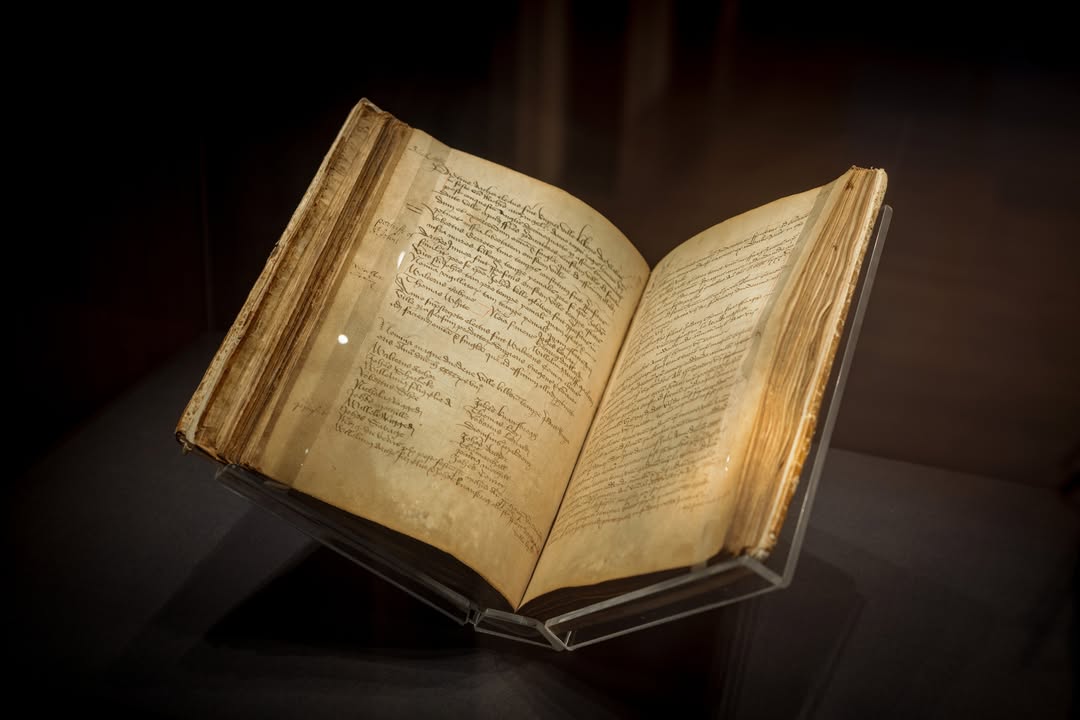
Liber Primus Kilkenniensis – Kilkenny’s Oldest Civic Record
Some objects do more than record facts. They give us a living sense of a place and the people who shaped it. In Kilkenny, few documents achieve this as profoundly as Liber Primus Kilkenniensis, often called the First Book of Kilkenny.

At first glance, it is a modest manuscript: a vellum book bound in oak boards, measuring approximately 23.5 by 17.6 centimetres and written in multiple medieval hands. Yet within its 174 pages lies a remarkable journey through more than two centuries of city life, spanning the early 1200s into the 1500s.
This was no book of saints or scripture. It was a town book, meticulously maintained by the Corporation of Kilkenny, documenting how the city governed itself. Here, one can trace early civic ordinances, elections of town officials, appointments of freemen, and even rules governing the price of bread and ale.
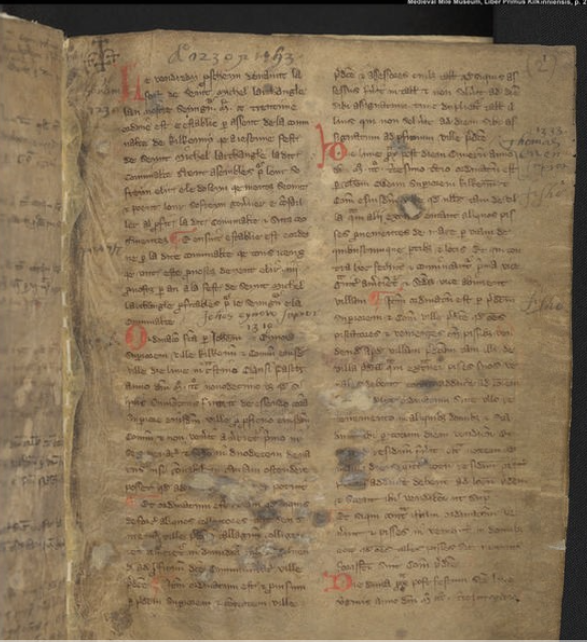
One entry, dated 1231, marks a defining moment in Kilkenny’s municipal life: an annual gathering of the community to elect its leaders. This is among the earliest independent records of its kind in Ireland, revealing a community actively shaping its own future.
As the centuries pass, the entries grow richer in detail. They record not only routine civic business, but also disputes, legal agreements, public works, and the rules that determined civic status. Liber Primus Kilkenniensis is more than ink on vellum, it is a testament to the real people, leaders, merchants, tradespeople, and citizens, whose choices shaped the city.
When you looking at the Liber Primus, you are not simply looking at old writing. You are connecting, page by page, with the living heart of Kilkenny’s past.
Kilkenny’s Oldest Civic Record Goes Digital
Some books are more than objects, they are voices carried across centuries, holding the memories, decisions, and daily lives of those who built our cities. For Kilkenny, that voice lives in Liber Primus Kilkenniensis, now carefully digitised and made available worldwide through Irish Script on Screen (ISOS).
What was once accessible only to a select group of scholars can now be explored by anyone with curiosity and a love of history.
A Book Born with the City
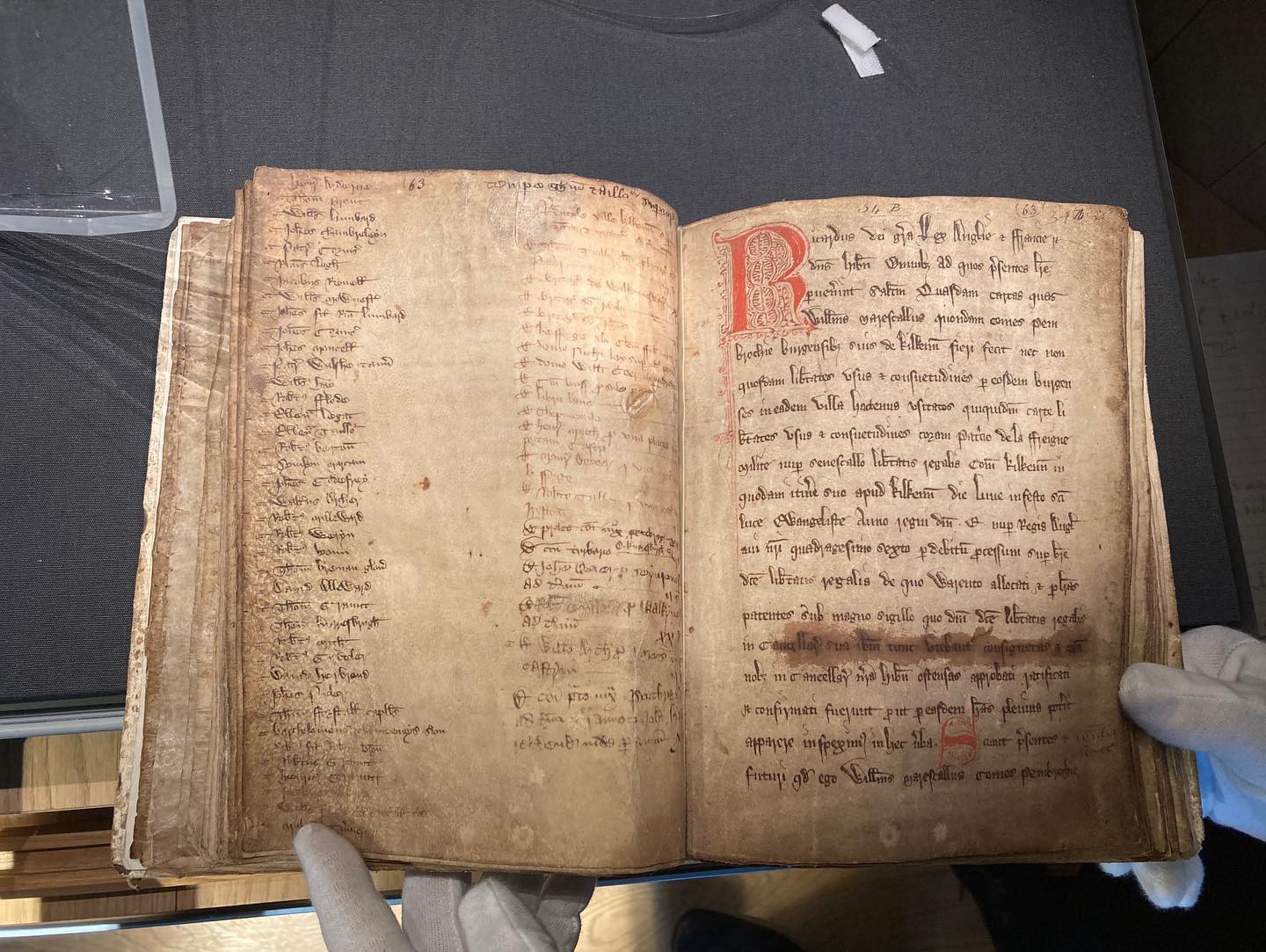
Liber Primus is no ordinary manuscript. This small vellum volume, consisting of 86 folios bound in oak, records civic life in Kilkenny from 1230 to 1538. At nearly 800 years old, it is one of Ireland’s most significant surviving town books.
Its pages preserve:
- Grants and charters from the 13th century
- Early civic regulations issued under William Marshal and his son
- Legal agreements between feudal lords and townspeople
- Records of governance, authority, and responsibility within the medieval city
Through these entries, we see how Kilkenny functioned as a living, breathing community: who held power, how disputes were resolved, and how order was maintained.
Yet what makes Liber Primus so compelling is not only its political significance, but its humanity. Its pages reveal the lives of ordinary people: stubborn, hopeful, ambitious, flawed, the same qualities that shape communities today.
The Ordinary Lives Behind the Ink
Between formal records lie glimpses of daily life: penalties for misconduct, notes on behaviour, and rules designed to keep peace in a bustling medieval town. These details animate the manuscript, transforming it from a historical record into a personal connection with Kilkenny’s past.
Preserving the Past, Opening Access
Manuscripts are fragile. Vellum ages, ink fades and handling leaves its mark. Digitising Liber Primus ensures its long-term preservation while opening it to the world.
Through the work of ISOS, part of the School of Celtic Studies at the Dublin Institute for Advanced Studies (DIAS), every page has been captured in exquisite detail. Readers can explore the texture of the vellum, the medieval handwriting, and marginal notes that reveal centuries of civic life. The manuscript is no longer confined to a single archive. It can now be studied in schools, universities, libraries, and homes worldwide. Kilkenny’s story has become part of the world’s story.
Collaboration and Expertise
This work has only been possible through dedication and collaboration. Special thanks are due to Dr Anne Marie O’Brien, Professor Pádraig Ó Macháin (University College Cork), and the continued support of Kilkenny County Council. Their scholarship ensures that one of Kilkenny’s greatest cultural treasures is preserved with care, accuracy, and respect.
Returning to Public Display
Following a period of conservation, Liber Primus Kilkenniensis will return to public display at the Medieval Mile Museum. Visitors will once again encounter the book not merely as an object behind glass, but as a witness to nearly three centuries of civic life.
For locals, it offers a tangible connection to the foundations of their city. For visitors, it presents a rare opportunity to engage with one of Ireland’s most significant civic manuscripts in its original context.
Why Liber Primus Still Matters
In a world where history can feel distant, Liber Primus reminds us that communities are shaped slowly, collectively, and carefully. Its pages speak of responsibility, identity, fairness, and belonging, values as relevant today as they were in 1230.
By bringing this manuscript online, Kilkenny does more than preserve its heritage. It invites curiosity, conversation, and connection. The past is no longer silent. It is here to be read, questioned, and understood.
Explore Liber Primus Online
Click Here to View the Liber Primus Manuscript.
And when it returns to display, we invite you to visit the Medieval Mile Museum and experience the real manuscript, where ink, vellum, and centuries of history meet in the heart of Kilkenny.
Discover more about Medieval Kilkenny through our guided tours, immersive exhibits, and special events.
Click here to book your visit today.
For more info
Visit: www.medievalmilemuseum.ie
Call: 056 781 7022 | Email: info@medievalmilemuseum.ie